When Was Night Vision Invented? A Timeline of Night Vision Technology
Quick answer: Practical night vision technology was first developed in the 1930s and used during World War II. Early systems were active infrared devices, meaning they needed an infrared light source to illuminate the target. Later generations improved image intensifier tubes, reduced the need for active illumination, and made night vision smaller, lighter, and more useful for military, law enforcement, hunting, navigation, and observation.
- 1930s: early active infrared night vision systems were developed.
- World War II: Germany and the United States used early infrared sighting systems.
- Generation 0: active infrared devices that required an illuminator.
- Generation 1: passive starlight devices became more practical in the 1960s.
- Modern night vision: Gen 2, Gen 3, white phosphor, digital night vision, and fusion systems expanded use far beyond early military experiments.
What Is Night Vision?
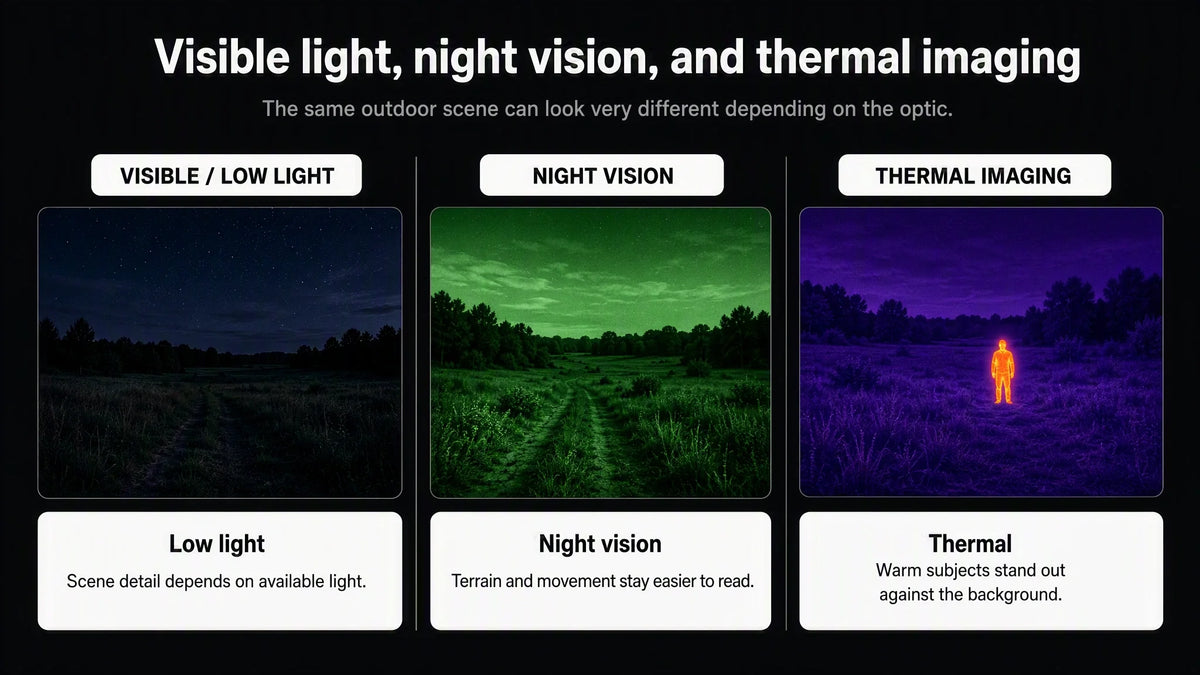
Night vision is a group of technologies that help people see in low light or darkness. Traditional night vision devices amplify available light from the moon, stars, or nearby artificial sources. Digital night vision uses sensors and displays. Thermal imaging is different: it detects heat rather than reflected light.
When people ask who invented night vision, the answer is not a single inventor working alone. Night vision developed through military research, optical engineering, infrared science, electronics, and later semiconductor and sensor improvements. The early breakthroughs came in the 1930s, and the technology continued to evolve through every major generation of optical and electronic warfare.
Night Vision Timeline
| Period | Technology Stage | What Changed | Limitations |
|---|---|---|---|
| 1930s | Early infrared research | Active infrared viewing and sighting systems began to appear. | Large, experimental, and dependent on infrared illumination. |
| World War II | Generation 0 | Military night sights and infrared systems were used in limited roles. | Heavy equipment, short range, and visible vulnerability to other infrared viewers. |
| 1960s | Generation 1 | Passive starlight scopes made night vision more practical without constant active IR light. | Lower resolution and more distortion than later devices. |
| 1970s–1980s | Generation 2 | Microchannel plate technology improved gain, clarity, and usefulness. | More capable but still expensive and specialized. |
| 1980s–present | Generation 3 | Gallium arsenide photocathodes improved sensitivity and performance. | Higher cost and export restrictions in many contexts. |
| 2000s–present | Digital and fusion systems | Digital night vision, thermal fusion, recording, wireless features, and compact devices expanded civilian and professional use. | Performance depends heavily on sensor quality, display, processing, and power. |
Who Invented Night Vision?
Night vision cannot be credited to one person in the way a single mechanical invention sometimes can. Early practical night vision grew out of German and American military research before and during World War II. German engineering firms and military programs developed early infrared systems, while the United States developed infrared sniperscope technology for military use.
The first systems were not like today’s compact goggles or weapon sights. They were heavy, active infrared devices that required an illuminator. Because the system projected infrared light, another force with compatible equipment could potentially detect the source. That weakness is one reason later passive devices became so important.

Generation 0: The First Practical Night Vision
Generation 0 night vision refers to early active infrared systems. These devices used an infrared light source and a viewer sensitive to that infrared light. They allowed a soldier or operator to see at night, but they were bulky and limited.
Key characteristics of Generation 0 systems:
- Required an active infrared illuminator.
- Were heavier and less portable than later devices.
- Had limited range and image quality.
- Could reveal the user to opponents with infrared detection capability.
Generation 1: Passive Night Vision Becomes Practical
Generation 1 night vision made a major leap by amplifying ambient light rather than relying entirely on an infrared spotlight. These devices could use moonlight and starlight to create a visible image. That made them more tactically useful and more practical in the field.
Generation 1 devices still had limitations. They were not as clear as modern night vision, and edge distortion was common. However, they introduced the basic idea most people associate with night vision: seeing in low light without shining a visible light.
Generation 2 and Generation 3
Generation 2 night vision improved performance by using a microchannel plate, which multiplied electrons more efficiently and produced a brighter, clearer image. Generation 3 improved sensitivity further with advanced photocathode materials, making devices more capable in very low light.
| Generation | Best Known For | Typical Strength | Common Use |
|---|---|---|---|
| Gen 1 | Early passive amplification | Lower cost and basic night observation | Entry-level night viewing |
| Gen 2 | Microchannel plate amplification | Better clarity and brightness | Professional and tactical use |
| Gen 3 | High sensitivity image intensifier tubes | Stronger low-light performance | Military, law enforcement, high-end civilian applications |
| Digital night vision | Sensor and screen-based viewing | Recording, lower light sensitivity tradeoffs, flexible features | Hunting, scouting, observation, entry-level devices |

Night Vision vs Thermal Imaging
Night vision and thermal imaging are often discussed together, but they work differently. Night vision needs light to amplify. Thermal imaging detects heat signatures and can work in total darkness. Night vision is often better for identifying shape, detail, and terrain under low-light conditions. Thermal imaging is often better for detecting living beings or heat sources through darkness, brush, or visual clutter.
| Feature | Night Vision | Thermal Imaging |
|---|---|---|
| Primary input | Available light | Heat / infrared radiation |
| Works in total darkness? | Usually needs some light or IR illumination | Yes |
| Best for | Navigation, identification, natural scene detail | Detection, locating warm objects, scanning fields or brush |
| Common AGM categories | Night vision devices | Thermal optics |
Why Night Vision Changed Military and Civilian Observation
Before night vision, darkness limited movement, target identification, security, and observation. Artificial lights could help, but they also exposed the user. Night vision changed that relationship by making low-light environments more usable.
Today, night vision supports many applications:
- military and law enforcement operations;
- search and rescue;
- night hunting where legal;
- property security and surveillance;
- navigation, boating, and outdoor observation;
- wildlife and farm monitoring.

Modern AGM Night Vision Options
Modern night vision buyers do not need to think only in terms of military history. The practical question is what type of device fits the job. A handheld monocular, binocular, goggle, rifle scope, or clip-on system can solve very different problems.
- Night vision monoculars are compact for handheld observation.
- Night vision binoculars support two-eye viewing and longer observation sessions.
- Night vision goggles are useful for hands-free movement and navigation.
- Night vision rifle scopes support aiming in low-light conditions where legal and appropriate.
FAQ
When was night vision invented?
Practical night vision systems were developed in the 1930s and used during World War II. Those early systems were active infrared devices that required an infrared illuminator.
Who invented night vision?
Night vision was developed through military and engineering research rather than by one single inventor. Early practical systems came from German and American work on infrared viewing and sighting technology.
What was the first generation of night vision?
The earliest practical devices are often called Generation 0. They used active infrared illumination and were much larger and more limited than modern devices.
Is thermal imaging the same as night vision?
No. Night vision amplifies available light, while thermal imaging detects heat. Thermal can work in total darkness, while traditional night vision usually needs some ambient light or IR illumination.
What generation of night vision is best?
The best choice depends on the use case and budget. Gen 3 devices generally offer strong low-light performance, while digital night vision can offer recording and modern features at different price points.
Sources
- Encyclopaedia Britannica — Night vision device
- U.S. Army — Night vision technology evolves from past to present
- U.S. Army Night Vision and Electronic Sensors Directorate