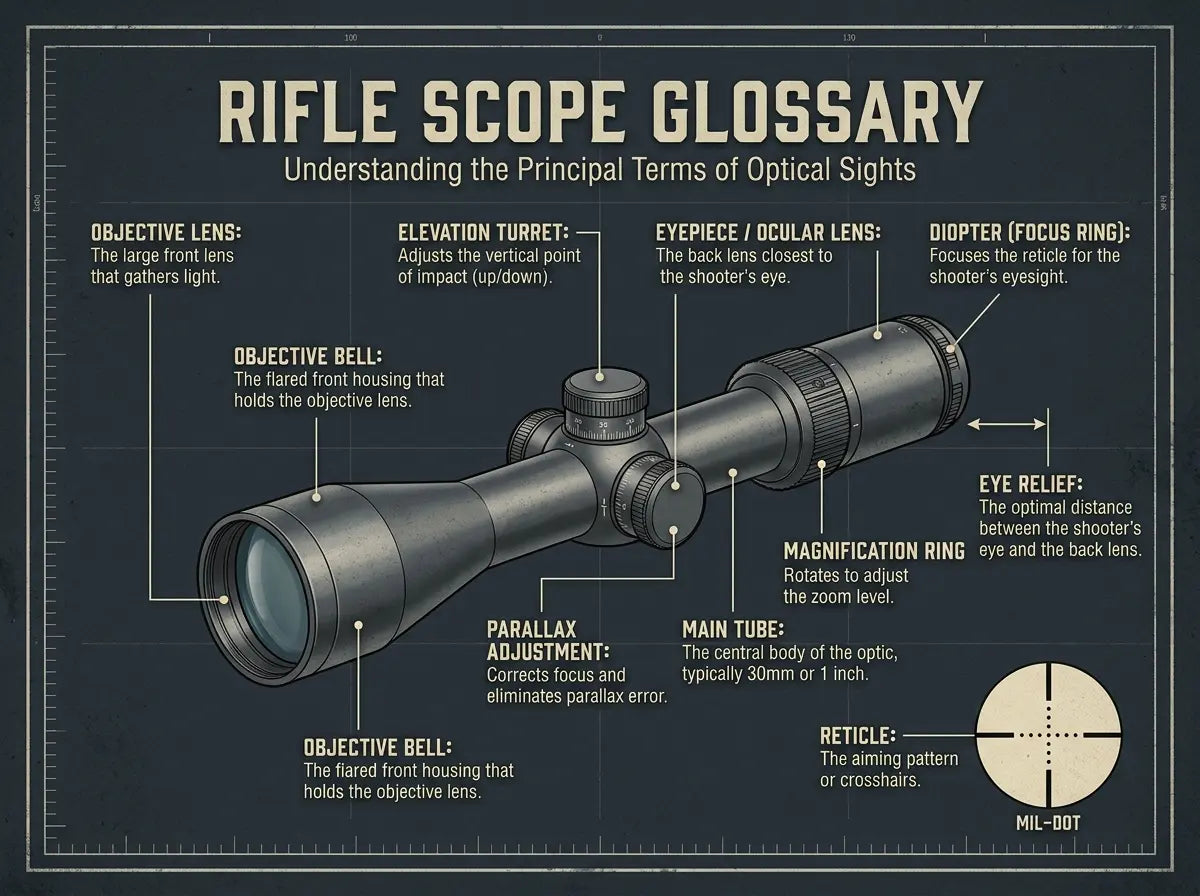
Night vision lenses are the optical parts that collect, focus, and deliver light in an image-intensifying night vision device. They are not contact lenses that let the wearer see in the dark: in a conventional night vision optic, a front objective lens gathers light, an image intensifier tube converts and amplifies the signal, and an eyepiece lets the user view the resulting image. An infrared (IR) illuminator can add near-infrared light when ambient light is insufficient, but it is illumination—not the objective lens or the intensifier itself.
TL;DR
“Night vision lens” usually refers to one or both glass lens assemblies in an image-intensifier device. The objective forms an image on the intensifier; the intensifier turns available photons into an amplified electronic image; the eyepiece magnifies that output for the eye. Lens aperture, focal length, focus range, field of view, coatings, and compatibility matter. An IR illuminator may help in very dark conditions, while thermal imaging is a different technology that detects infrared radiation emitted by objects.
Night vision lenses at a glance
| Part or term | Where it is | What it does | What it does not do |
|---|---|---|---|
| Objective lens | Front of the device | Collects and focuses scene light onto the image intensifier | Does not amplify light by itself |
| Image intensifier | Inside the optical path | Converts incoming photons into electrons, multiplies the signal, and forms a visible output image | Is not a lens; it is the electronic image-amplifying component |
| Eyepiece / ocular lens | At the viewing end | Magnifies and presents the output image to the user’s eye | Does not gather the scene as the objective does |
| IR illuminator | Usually mounted on or integrated into the device | Projects near-infrared illumination that some night vision devices can detect | Is not a lens, and should not be confused with thermal imaging |
What “night vision lenses” means
The phrase is used loosely. It may mean the objective lens at the front, the eyepiece through which the user looks, the complete optical assembly, or—in casual marketing language—the lenses on a night vision monocular, binocular, goggles, or riflescope. In ordinary image-intensifier equipment, it does not mean a special standalone piece of glass that creates night vision. The lens assemblies shape the light; the intensifier provides the amplification.
That distinction helps when comparing equipment or looking for replacement parts. A front objective and an ocular have different positions, optical jobs, dimensions, and compatibility requirements. The device’s manual or manufacturer specifications should identify the correct component. Do not assume that a lens from one model will fit another just because both devices are called night vision.
How the objective lens, intensifier, and eyepiece work together
- The objective collects scene light. Moonlight, starlight, and other available light enter through the front objective. Its optical design brings the scene into focus at the intensifier’s input surface. A larger effective aperture can admit more light, but performance also depends on the intensifier, optical transmission, focus, and the scene’s lighting.
- The intensifier converts and amplifies the signal. In a typical image-intensifier tube, incoming photons reach a photocathode, which releases electrons. The tube multiplies those electrons and converts the resulting pattern back into a visible image at its output screen. The exact tube design varies by generation and model; the general point is that amplification happens in the tube, not in the glass objective.
- The eyepiece presents the output image. The ocular magnifies the image formed by the intensifier so it can be viewed comfortably. Its diopter adjustment, where provided, is set for the user’s eyesight; it is not the same as focusing the objective on a distant target.
- Optional IR illumination supplements the scene. If there is too little ambient light, a compatible IR illuminator can shine near-infrared light onto the scene. The device’s intensifier may then detect reflected IR. This can make nearby objects easier to see, but it does not turn an image intensifier into a thermal sensor, and the practical result depends on illuminator range, beam pattern, atmosphere, and device sensitivity.
The chain is therefore: scene light → objective lens → image intensifier → eyepiece → eye. When an IR illuminator is used, it adds light to the scene before that light enters the objective. This simple model prevents a common misunderstanding: people sometimes attribute the bright image to “night vision lenses,” even though the intensifier is the active amplification stage.

Objective lens: the front optic
The objective lens points toward the scene. It gathers light and forms an image on the intensifier’s input. Its focal length influences the optical system’s magnification and field of view. In many designs, a longer effective focal length produces more magnification but a narrower view; a wider view can make it easier to scan surroundings, while a narrower view may help inspect a more distant area. These are system-level tradeoffs, not guarantees about detection distance.
The objective’s focus is set for the scene distance. Some devices use a manual focus ring; other compact designs use a fixed or limited-focus arrangement. If the image remains soft after the eyepiece diopter is set, adjust the objective focus according to the manufacturer’s instructions. Focusing the ocular for your eye does not refocus the outdoor scene.
Aperture and optical transmission also matter. A lens with a larger opening can potentially pass more light, but the final view depends on more than diameter: lens quality, coatings, the tube, alignment, and environmental light all contribute. A specification such as an f-number describes the relationship between focal length and aperture; it should be interpreted alongside the rest of the device’s published specifications rather than as a complete performance rating.
Eyepiece: the viewing optic
The eyepiece, also called the ocular, sits at the user-facing end. It takes the output image from the intensifier and lets the eye inspect it. Eyepiece design affects viewing comfort, eye relief, apparent image size, and how much of the image is visible at once. Eye relief is the distance between the eyepiece and the eye at which the full view can be seen. Users wearing glasses should check the device’s instructions and eye-relief specifications rather than assume every model works equally well with eyewear.
Many devices provide a diopter adjustment to compensate for differences in eyesight. Follow the maker’s setup sequence: typically the ocular is adjusted for the user’s vision and the objective is then focused on the target. Avoid forcing adjustment rings or attempting to disassemble a sealed optical assembly. Some devices contain delicate, high-voltage image-intensifier components; servicing should be left to qualified technicians.
What lens specifications should you compare?
- Focal length and magnification: Consider how much detail you need and whether a narrower field of view is acceptable. Magnification is not the same as resolution or identification capability.
- Field of view: A wider view supports scanning and situational awareness; higher magnification generally reduces the visible area. Compare the stated field of view using the same units and measurement method.
- Objective aperture and optical transmission: These relate to light collection, but do not evaluate the lens in isolation from the intensifier and full device.
- Focus range: Check whether the device can focus at the distances relevant to your use and how it is adjusted.
- Eye relief and diopter range: These affect comfort and whether the ocular can be adjusted for your eyesight or eyewear.
- Lens coatings and protection: Coatings can affect reflection and transmission; protective covers and care guidance help prevent damage. Follow the model’s cleaning instructions.
- Mounting and compatibility: Verify thread, bayonet, objective diameter, adapter, and model requirements with the manufacturer. Similar appearance does not establish compatibility.
- Complete-system performance: Look at tube specifications and device-level information as well as lens data. A lens specification alone cannot establish how well a device will perform in a particular environment.

Night vision lenses versus thermal imaging
Image-intensifier night vision works with available light (including reflected near-infrared illumination when equipped). Thermal imaging detects differences in infrared energy emitted by objects and displays those differences as an image. These are different sensing methods, and neither should be described as simply a special lens. A thermal device has its own optical system, but the detector—not a night vision intensifier—captures the thermal signal. For a fuller comparison, see AGM’s guide to night vision vs. thermal optics.
Which approach fits depends on the task, conditions, and device. Image intensification can show a scene using available or added near-IR light; thermal can reveal temperature contrasts without relying on visible scene illumination. Atmospheric conditions, background temperatures, resolution, lens choice, and user requirements affect results. Avoid assuming that either technology guarantees detection or identification at a particular distance.
Practical care and safe use
Keep objective and eyepiece caps on when the device is not being used, and clean exposed optics only as directed by its manual. Dust should be removed with an appropriate blower or soft optical brush before wiping; grit dragged across a lens can scratch coatings. Use approved lens tissue or cloth and cleaner if the manufacturer permits them. Do not use household cleaners, solvents, or excessive pressure unless explicitly approved.
Use only power settings and operating procedures specified for the device. Bright light can damage some image-intensifier tubes, so do not point the optic toward the sun or expose it to bright sources contrary to its manual. IR light is invisible or difficult to see, but an illuminator can still be detected by equipment sensitive to its wavelength; do not assume it is undetectable. Observe applicable laws, property boundaries, firearm safety rules, and the device’s warnings.
For product selection, begin with the intended application and operating conditions, then compare the complete device and confirm lens compatibility. AGM’s night vision product range provides model-level information; use the specific product page and manual for exact specifications. To understand the broader technology, see AGM’s night vision history article.
FAQ
Are night vision lenses the same as night vision contact lenses?
No. In conventional night vision equipment, “lenses” means the objective and eyepiece optics used with an image intensifier. They are not contact lenses that independently provide night vision.
Sources
- National Institute of Justice, Scoping Out Night Vision — overview of objective lens, image intensifier, eyepiece, and basic image-intensification operation.
- U.S. Department of Homeland Security, Night Vision – Image Intensification Technologies — technical note on image intensification and infrared illumination.