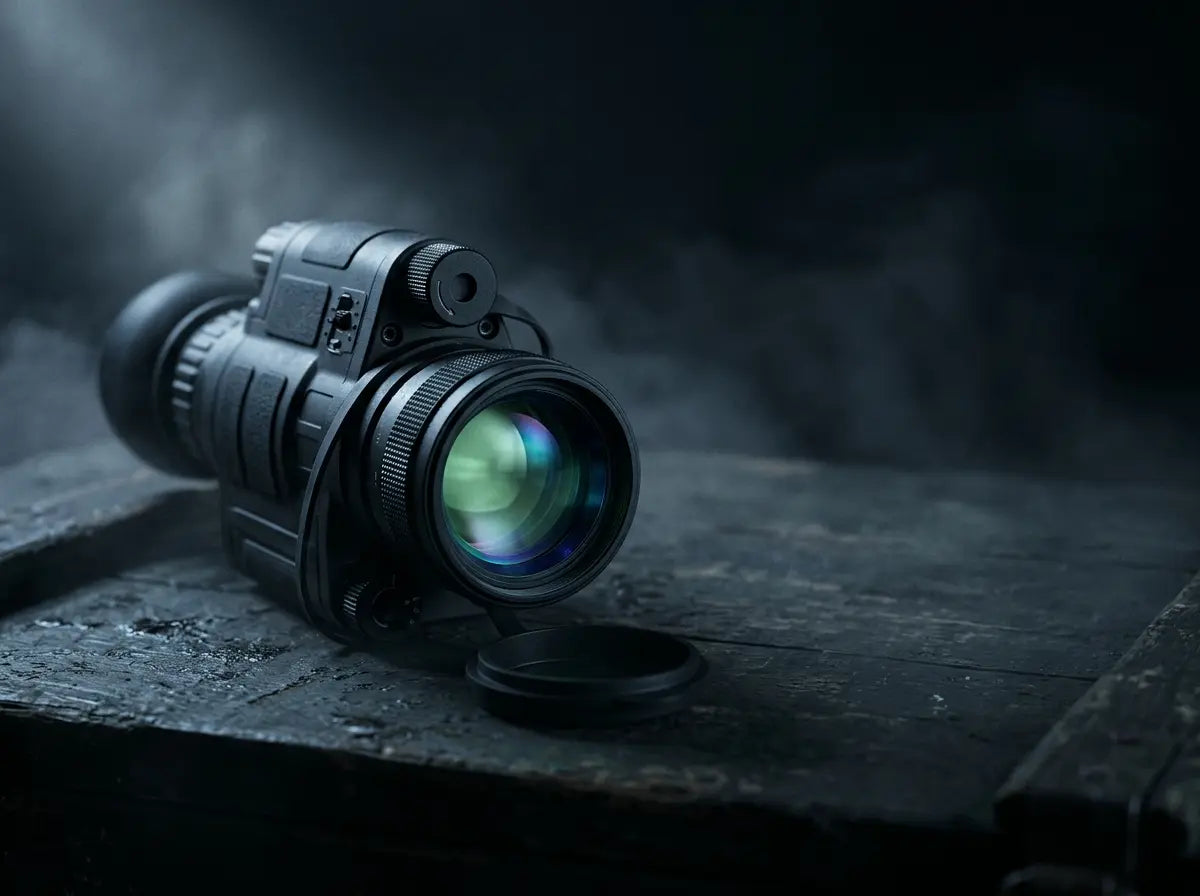
Rifle Scope Glossary of Terms
This rifle scope glossary explains the principal terms that appear in descriptions of optical sights and other observation optics.
Key Rifle Scope Terms Explained
- Magnification. Shows how much larger an object appears through the optics compared with observation by the naked eye.
- Objective Lens. The front lens of a rifle scope. Its diameter influences the amount of light that the optical system can collect.
- Field of View, FOV. Determines what area of space is visible through the optics.
- Eye Relief. The distance from the eyepiece to the eye position at which a complete image remains visible.
- Exit Pupil. Characterizes the diameter of the light beam emerging from the eyepiece.
- MOA and MIL. Angular units used for measuring adjustments and marking certain reticles.
- Reticle. A system of lines and marks within the field of view.
- Turrets. Controls for vertical and horizontal adjustments.
- Parallax Adjustment. Helps reduce the apparent displacement of the reticle relative to the target image when the eye position changes.
How to Read Rifle Scope Specifications
For rifle scope numbers explained, let us examine a common marking format that makes it possible to quickly identify the main optical parameters of a scope. Most frequently, it contains two numbers separated by the × symbol, or a range of values and a third number.
As an example, consider the designation 3–9×40:
- 3 – minimum magnification. The object appears three times larger than when observed with the naked eye.
- 9 – maximum magnification. The user can change the magnification within the range from 3× to 9×.
- 40 – objective lens diameter in millimeters. It is 40 mm.
If only one magnification value is indicated, for example 6×42, this is a scope with fixed magnification. It cannot be changed.
Table 1. Key Scope Numbers and What They Mean
| Designation | What it means | What to pay attention to |
|---|---|---|
| 3–12×50 | Magnification 3–12×, 50 mm objective lens | Magnification range and device dimensions |
| 4×32 | Fixed 4× magnification, 32 mm objective lens | Absence of magnification adjustment |
| 30 mm tube | Main tube diameter of 30 mm | Compatibility with mounting rings |
| 0.25 MOA/click | One click of the adjustment mechanism corresponds to 0.25 MOA | Scope adjustment increment |
| 0.1 MIL/click | One click corresponds to 0.1 MIL | Correspondence of adjustment units to reticle markings |
| 3.5 in eye relief | Eye relief of approximately 89 mm | Distance between the eye and the eyepiece |
| FFP / SFP | First Focal Plane / Second Focal Plane | Change in the apparent reticle size when magnification changes |
| AO / SF | Adjustable Objective / Side Focus | Method of parallax adjustment |
Core Optical Terms: Magnification, Objective Lens, Field of View, Eye Relief, Exit Pupil
These five concepts constitute the foundation of scope terminology. They help to understand what the image through the optics will be like, how comfortable observation through the eyepiece will be, and what compromises are incorporated into the device's construction.
Magnification
Magnification indicates how many times larger a distant object appears when observed through a rifle scope compared with the naked eye.
Scopes are divided into two types:
- Fixed magnification (with constant magnification). They have a simpler optical construction without a mechanism for changing magnification.
- Variable magnification (with adjustable magnification). They allow changing the image scale within the provided magnification range.
High magnification helps examine small details of distant objects, but simultaneously narrows the field of view and makes image fluctuations more noticeable.

Objective Lens
Objective lens is the front optical element of the scope that collects light from the observed object. Its diameter is specified in millimeters. A larger objective lens can potentially collect more light.
Field of View, FOV
Determines the width of the area visible through the scope at a specified distance. In American specifications, this parameter is usually expressed in feet at 100 yards (ft @ 100 yd), while in the metric system it is expressed in meters at 100 meters.
For example, FOV 30 ft @ 100 yd means that at a distance of 100 yards, an area approximately 30 feet wide is visible through the scope.
A wide field of view facilitates observation of the surrounding space and searching for objects. A narrow one allows concentrating on a small section of the image.
Eye Relief
The distance between the scope eyepiece and the eye at which the user sees the complete image without darkening around the edges.
Insufficient distance between the eye and the eyepiece may create a risk of injury from weapon recoil.
Exit Pupil
The diameter of the light beam emerging from the scope eyepiece. For a conventional optical scope, it is approximately calculated using the formula:
Exit pupil = Objective lens diameter / Magnification
For example, for a 4–16×40 scope, the exit pupil diameter is:
- at 4× magnification – 10 mm;
- at 8× magnification – 5 mm;
- at 16× magnification – 2.5 mm.
The smaller the exit pupil, the more precisely the eye must be positioned relative to the optical axis to see the complete image.
Reticle and Adjustment Terms
Descriptions of rifle scopes contain terms related to reticle construction, angular measurement systems, and adjustment mechanisms. Let us examine the principal designations from this group of rifle scope terminology.
Reticle
A reticle is a system of lines, dots, or other marks within the scope's field of view. The simplest version is a crosshair. More sophisticated reticles may include additional angular divisions and marks for estimating distances.
According to their position within the optical system, two types of reticles are distinguished:
- First Focal Plane (FFP). A reticle in the first focal plane. Its apparent size changes together with magnification, while the angular intervals between marks remain constant.
- Second Focal Plane (SFP). A reticle in the second focal plane. Its apparent size remains practically unchanged when magnification changes, but the angular values of the markings correspond to their nominal values only at a particular magnification specified by the manufacturer.
There are conventional and illuminated reticles. Illumination helps distinguish the crosshair against a dark background. It does not increase the brightness of the observed image and does not transform a conventional optical scope into a night vision device.

MOA and MIL
MOA (Minute of Angle) and MIL (Milliradian) are two angular measurement systems used in reticle markings and adjustment mechanisms.
MOA corresponds to one angular minute, or 1/60 of a degree. MIL corresponds to one thousandth of a radian (milliradian, mrad). 1 MIL ≈ 3.44 MOA.
MOA vs. MIL: what is the difference?
Table 2. MOA vs MIL – comparison of measurement systems
| Parameter | MOA | MIL |
|---|---|---|
| Full name | Minute of Angle | Milliradian (mrad) |
| Angular value | 1/60 of a degree | 0.001 radian |
| Linear size at 100 yards | Approximately 1.047 inches | 3.6 inches |
| Linear size at 100 meters | Approximately 2.91 cm | 10 cm |
| Example of adjustment increment | 0.25 MOA per click | 0.1 MIL per click |
| Designation in specifications | MOA, MOA/click | MIL, MRAD, MIL/click |
Windage and elevation turrets
Turrets are mechanical controls designed to change the reticle position relative to the image. Usually, a scope is equipped with two turrets:
- Elevation turret for vertical adjustment.
- Windage turret for horizontal adjustment.
Some scopes feature a locking mechanism for the controls to prevent accidental changes in settings.
Click Value
Indicates the magnitude of angular change corresponding to one fixed step of the adjustment mechanism. This parameter is specified in MOA or MIL.
The click value characterizes the discreteness of adjustment.
Zero Stop
Zero stop is a mechanism that allows returning to the previously established zero position of the elevation turret without the necessity to keep track of the number of revolutions.
Holdover
Holdover is a term referring to the use of reticle marks to account for vertical deviation without changing the position of the adjustment turret.
For this purpose, some reticles contain additional horizontal lines, dots, or other marking elements. Such configurations may be designated as BDC (Bullet Drop Compensating) or have an MOA/MIL angular scale.

Focus and Image Terms
Parallax
This is the apparent displacement of the reticle relative to the target image when the eye position behind the eyepiece changes. The effect occurs when the target image and the reticle are situated in different optical planes.
Most scopes without parallax adjustment are factory-set for a specific distance, for example 100 yards. At other distances, an error may appear, particularly noticeable at high magnification.
The presence of a parallax adjustment mechanism allows aligning the planes of the target image and the reticle for the selected distance.
AO (Adjustable Objective)
AO is a parallax adjustment system using a rotating ring on the objective lens.
The ring may carry distance values in yards or meters. When it is rotated, the position of optical elements changes, making it possible to adjust the target image into the reticle plane.
Side Focus
Side focus performs the same principal function as AO, but the control is located on the side of the scope body, usually opposite the windage turret.
This arrangement allows changing the setting without reaching toward the front part of the objective lens.
Diopter Adjustment
Designed to adjust reticle sharpness according to the individual characteristics of the user's eyesight. Usually, adjustment is performed by rotating a ring on the eyepiece.
Light Transmission
Light transmission is the proportion of light passing through the scope's optical system. The parameter is expressed as a percentage and depends on the properties of the glass, the number of optical surfaces, and the quality of anti-reflective coatings.
The following designations may appear in specifications:
- Coated optics. An anti-reflective coating is applied to at least one optical surface.
- Fully coated optics. All glass–air interfaces have a single-layer anti-reflective coating.
- Multicoated optics. A multilayer coating is applied to at least one optical surface.
- Fully multicoated optics. All glass–air interfaces have multilayer anti-reflective coatings.
Coatings reduce light losses caused by reflection and can enhance image contrast.
Resolution and Image Contrast
Optical resolution characterizes the ability of an optical system to distinguish small details located close to each other.
Image contrast determines the difference between light and dark areas of the image. It influences how well the outlines and details of objects can be distinguished against the surrounding environment.
Scope Types and Mounting Terms
When choosing optics, it is necessary to consider not only their characteristics but also their structural compatibility with mounts and additional devices. In rifle scope nomenclature, the following terms are used to describe these parameters.
Tube Diameter
The external diameter of the central body tube on which mounting rings are installed. The most common sizes are 1 inch (25.4 mm), 30 mm, and 34 mm.
Scope Rings and Mount
Rings that secure the scope to a weapon. They must correspond to the tube diameter. When choosing, the height of the rings is also considered, since it determines the position of the optical axis relative to the weapon.
Scope mount is a general designation for a mounting device. Besides separate rings, one-piece mounts are used, combining two fixation points in one construction.
Mount specifications may include the following designations:
- Cantilever mount. A bracket with the mounting section displaced relative to its base.
- Quick-detach (QD). A quick-release mount that allows removing the device without a conventional set of tools.
- Mounting height. The installation height of the optical axis above the mounting base.
Rail
A rail intended for installing compatible scopes and accessories. Common standards include Picatinny (MIL-STD-1913) and Weaver.
Clip-On Compatibility
Clip-on is an additional optical device installed in front of a compatible daytime scope. This construction allows adding a thermal image or night vision function while retaining the main scope.
The AGM Thermal Clip-Ons category includes thermal imaging attachments for joint use with daytime optics.
Thermal and Night Vision Terms Buyers Should Understand
Thermal scopes and night vision optics use different principles of image formation. Thermal imaging devices register infrared radiation from objects associated with their temperature. Night vision devices operate with reflected or self-emitted light radiation within the spectral range accessible to them. Therefore, when comparing such devices, it is necessary to consider additional technical characteristics.
Thermal Sensor Resolution
Shows the number of sensitive elements in the sensor array. For example, the designation 384×288 corresponds to 110,592 pixels, while 640×512 corresponds to 327,680 pixels.
With comparable optical characteristics and observation conditions, higher resolution allows distinguishing more details in the thermal image. However, the result also depends on the objective lens quality, sensor sensitivity, and signal processing algorithms.
NETD
NETD (Noise Equivalent Temperature Difference) characterizes the minimum temperature difference that a thermal imaging sensor is capable of distinguishing against its own noise. The parameter is measured in millikelvins (mK).
The lower the NETD, the higher the potential capability of the sensor to display subtle temperature differences. For example, the AGM product range includes devices with NETD below 15 mK.
Pixel Pitch
The distance between the centers of adjacent sensitive elements of a thermal imaging sensor array. It is usually specified in micrometers (µm), for example, 12 µm.
This parameter influences the physical dimensions of the sensor and, in combination with the objective lens focal length, the device's field of view.
Refresh Rate
Refresh rate shows how many times per second the image on the display is refreshed. It is measured in Hz. A higher frequency usually provides smoother representation of moving objects and reduces the noticeable delay between their movement and the image update.
Detection Range
The declared distance at which a thermal imaging device is capable of detecting an object under specified testing conditions.
Base Magnification and Digital Zoom
Base magnification is the initial image magnification provided by the optical and electronic systems of the device.
Digital zoom allows additional enlargement of the displayed image fragment. However, digital scaling does not increase the quantity of original details: the image is formed using pixels already obtained from the sensor.
When comparing thermal scope specs, it is necessary to distinguish between base magnification and maximum magnification including digital zoom.
Night Vision Terms
- Image Intensifier Tube (IIT). An electro-optical converter that amplifies available light and forms a visible image. Specifications of such devices use the designations Gen 2, Gen 3, resolution, SNR and FOM.
- SNR (Signal-to-Noise Ratio). The ratio of useful signal to noise.
- FOM (Figure of Merit). A parameter calculated as the product of the image intensifier tube resolution in lines per millimeter (lp/mm) and SNR.
- Digital Night Vision. A technology in which the image is registered by an electronic sensor and displayed on a screen.
- IR Illuminator. An infrared illuminator that creates additional lighting for compatible night vision devices.
Different technologies can be explored in the AGM Night Vision category. Thermal imaging devices are presented separately in the AGM Thermal Weapon Sights section.
Day Optic vs. Thermal Optic vs. Night Vision Optic Specs
Table 3. Comparison of characteristics of different optics types
| Parameter | Day optic | Thermal optic | Night vision optic |
|---|---|---|---|
| Image formation principle | Visible light passing through lenses | Registration of objects' own thermal radiation | Amplification of weak light (IIT) or registration of light by a digital sensor |
| Magnification | Optical magnification, for example 3–12× | Base magnification and digital magnification | Optical magnification; digital models may have digital zoom |
| Objective lens | Diameter in mm, for example 50 mm | More frequently focal length in mm; aperture and viewing angle are also important | Focal length / relative aperture; parameters depend on the technology |
| Resolution | Optical resolving power, frequently without a numerical designation | Thermal sensor resolution, for example 384×288 | IIT: lp/mm; digital device: sensor resolution |
| Sensitivity | Light transmission and optical quality | NETD, mK (lower is potentially better) | IIT: SNR, FOM; digital device: sensor sensitivity |
| Field of view (FOV) | Usually ft @ 100 yd or m @ 100 m | Angle in degrees or viewing width at a distance | Angular or linear value at a specified distance |

Quick Glossary Table
Table 4. Buyer glossary
| Term | Simple definition | Practical significance |
|---|---|---|
| Magnification | Image magnification factor. | Scale of the observed object. |
| Magnification range | Minimum and maximum magnification. | Flexibility of image scaling. |
| Objective lens | Front element that collects light. | Optical dimensions and light-gathering capability. |
| Exit pupil | Diameter of the light beam behind the eyepiece. | Observation comfort and performance in low light. |
| Eye relief | Distance from the eyepiece to the eye for a full view. | Comfort and safety of eye positioning. |
| Eyebox | Area of permissible eye positions behind the eyepiece. | Requirements for head positioning. |
| Field of view (FOV) | Width of the visible area at a specified distance. | Coverage of the surrounding space. |
| Reticle | Lines and marks within the field of view. | Format of aiming markings. |
| FFP | Reticle with constant angular intervals at different magnifications. | Behavior of markings when magnification changes. |
| SFP | Reticle with an almost constant apparent size. | Dependence of angular markings on magnification. |
| Illuminated reticle | A reticle with illumination. | Visibility of markings against a dark background. |
| MOA | Angular minute – 1/60 of a degree. | Units of scales and adjustments. |
| MIL / MRAD | Milliradian – 1/1000 of a radian. | Compatibility of reticle and turret designations. |
| Turret | Mechanical adjustment turret. | Construction of control elements. |
| Click value | Angular value of one turret click. | Discreteness of adjustments. |
| Zero stop | Limiter for returning to the established zero. | Presence of a mechanical stop. |
| Zero reset | Resetting the scale designation to zero. | Possibility of reassigning the scale's zero mark. |
| Parallax | Apparent displacement of the reticle relative to the target when the eye moves. | Availability and method of correcting the effect. |
| AO (Adjustable Objective) | Parallax adjustment using a ring near the objective lens. | Location of the adjustment control. |
| Side focus | Side-mounted parallax control. | Accessibility of adjustment. |
| Diopter adjustment | Adjustment of reticle sharpness. | Range of eyepiece adaptation to eyesight. |
| Light transmission | Proportion of light passing through the optical system. | Optical losses. |
| Tube diameter | External diameter of the central tube. | Size of compatible rings. |
| Mounting rail | Rail for installing optics. | Compatibility of the mounting interface. |
| Clip-on | Additional device in front of the main optics. | Requirements for component compatibility. |
| Sensor resolution | Number of elements in the sensitive sensor array. | Original detail level of the digital image. |
| NETD | Noise-equivalent temperature difference. | Sensitivity of the thermal imaging sensor. |
| Pixel pitch | Spacing of sensor array elements in micrometers. | Sensor geometry and field of view in combination with the objective lens. |
| Refresh rate | Image refresh frequency in hertz. | Smoothness of motion representation. |
| Detection range | Declared distance of object detection. | Conditions under which an object becomes noticeable. |
| Digital zoom | Electronic enlargement of an image fragment. | Difference between digital magnification and original image detail. |
| SNR | Ratio of useful signal to noise. | Noise level in image intensifiers. |
| FOM | Product of IIT resolution and SNR. | Combined indicator of IIT characteristics. |
| IR illuminator | Source of infrared illumination. | Requirement for additional lighting. |
How to Use This Glossary When Choosing an Optic
Let us examine which parameters deserve attention when choosing different types of optics.
Daytime Rifle Scopes
When comparing conventional rifle scopes, the appropriate magnification range is determined first. For observation at short distances and of moving objects, lower magnification and a wide field of view are convenient. Higher magnification may be necessary for studying small details of distant objects.
Additionally, eye relief, the reticle type (FFP or SFP), the availability of parallax adjustment, and the characteristics of adjustment mechanisms are evaluated. The compatibility of tube diameter with mounting rings is checked separately.
Thermal Scopes
When choosing a thermal scope, the key parameters are thermal sensor resolution, NETD, pixel pitch, and objective lens characteristics.
For observation of objects with low temperature contrast, sensor sensitivity is particularly important. Sensor array resolution and objective lens focal length influence image detail and field of view.
Night Vision Devices
For devices with IIT, the main indicators are the intensifier generation, resolution, SNR, and FOM. When comparing digital devices, sensor characteristics, image quality in low illumination, and infrared illumination capabilities are considered.
Thermal Imaging Attachments
When choosing a thermal clip-on, it is necessary first of all to check compatibility with the already installed daytime optics.
FAQ
What are the most important rifle scope terms for beginners?
Beginners should first of all understand five main characteristics: magnification, objective lens, eye relief, field of view, and reticle.
What does AO mean on a rifle scope?
AO means Adjustable Objective – parallax adjustment using a ring on the front part of the scope. It is very useful for devices with high magnification and when observing at different distances.
What is the difference between MOA and MIL?
MOA and MIL are different units of angular measurement. One angular minute (MOA) equals 1/60 of a degree, while one milliradian (MIL) equals 1/1000 of a radian. The relationship between them is approximately 1 MIL = 3.44 MOA.
What does objective lens size mean?
Objective lens size denotes the diameter of the scope's front lens in millimeters. For example, in the marking 3–9×40, the number 40 indicates an objective lens with a diameter of 40 mm.
What is eye relief and why does it matter?
Eye relief is the distance from the eyepiece to the eye at which the user sees the entire image. This parameter influences observation comfort and safety when using the scope on a weapon with noticeable recoil.
What is scope adjustment and which settings are available?
Scope adjustment is the general designation for rifle scope adjustments. These include windage and elevation for horizontal and vertical corrections, diopter adjustment for adjusting reticle sharpness, parallax adjustment for reducing parallax, and magnification adjustment for changing magnification.
Are thermal scope terms different from rifle scope terms?
Yes, because thermal scopes form an image using an infrared sensor rather than only a traditional optical system. In addition to common concepts such as magnification and field of view, thermal scope specs use NETD, pixel pitch, sensor resolution, and refresh rate.