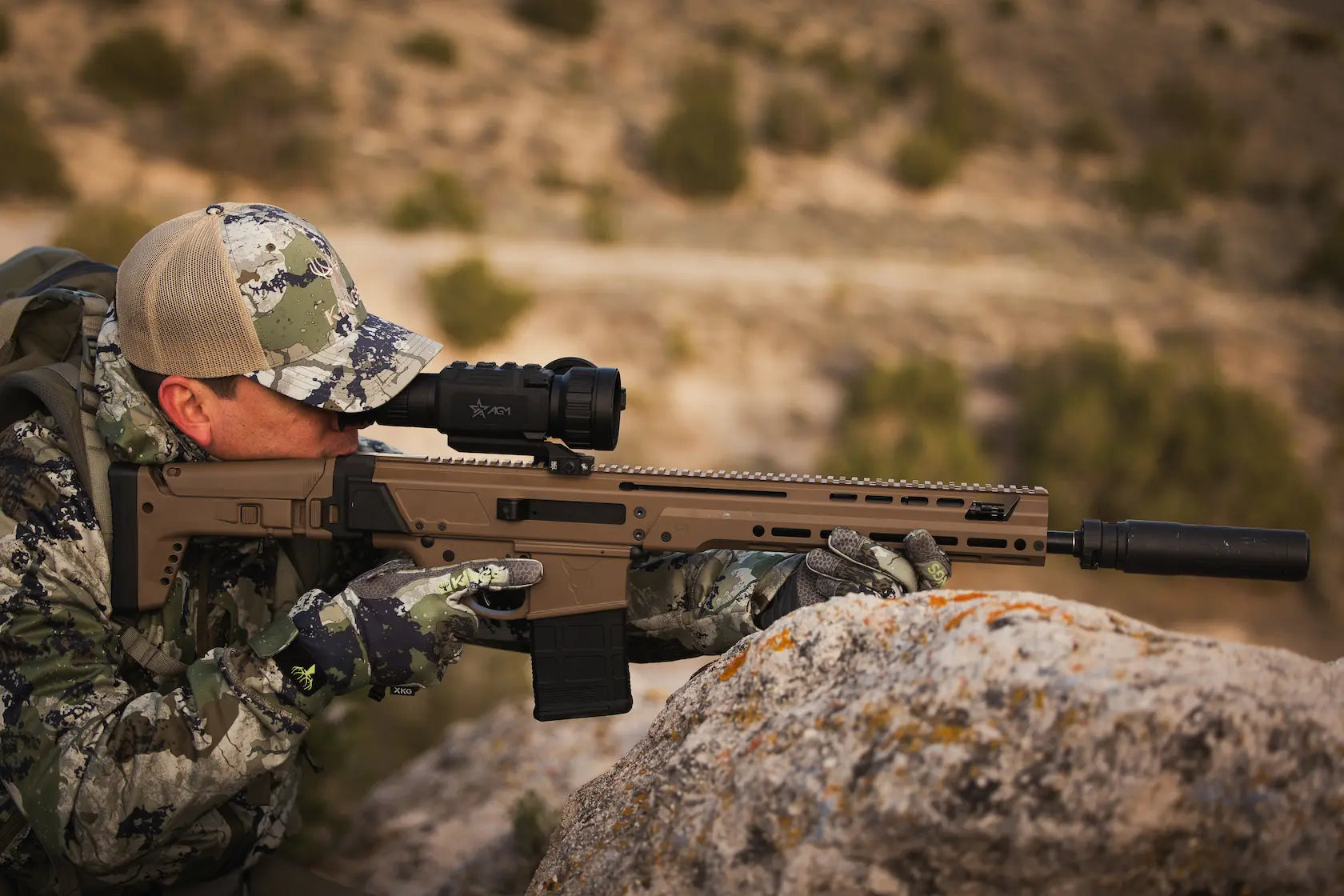
Article: 384 vs. 640 Thermal Resolution: Is the Upgrade Worth the Cost?
384 vs. 640 Thermal Resolution: Is the Upgrade Worth the Cost?
Thermal resolution is one of the first numbers buyers notice when comparing scopes and monoculars. A 384 thermal sensor can be a smart, capable choice for many real hunting and property use cases. A 640 thermal sensor gives more detail and usually feels easier to use at longer distance. The right choice depends on the lens, field of view, terrain, budget, and how much useful detail you need after the first heat detection.
When 640 is worth the upgrade
TL;DR: 640 thermal resolution is worth paying for when you scan open ground, use digital zoom often, or need more confidence after the first heat detection. 384 thermal resolution still makes sense for close to mid-range use, woods, smaller fields, and buyers who want strong value without paying for the highest sensor tier. The upgrade is useful, but lens, field of view, NETD sensitivity, display quality, and real working distance matter just as much as the sensor number.
384 vs 640 thermal resolution: is the upgrade worth it?
For many buyers, yes, 640 thermal resolution is worth the upgrade if the optic will be used often, across open terrain, or at distances where shape detail matters. More sensor pixels help the image hold together when the subject is small in the view. A 640 optic can make scanning feel calmer because the scene has more detail and less guesswork.
That does not mean every buyer needs 640. A 384 thermal scope or monocular can still detect animals, people, vehicles, and warm equipment effectively when the distance and terrain are realistic. If most use happens inside shorter fields, wooded lanes, feeders, barns, ranch roads, or property edges, a good 384 optic may be the better value.
What 384 and 640 actually mean
The number usually refers to the horizontal pixel count of the thermal sensor. A common 384-class sensor is 384×288. A common 640-class sensor is 640×512. The difference is not just a larger number on a spec sheet. It changes how many thermal samples the device captures from the scene.
| Sensor class | Typical sensor array | Approximate sensor pixels | What it means in use |
|---|---|---|---|
| 384 class | 384×288 | 110,592 pixels | Good practical detail for close to mid-range use, especially when paired with the right lens. |
| 640 class | 640×512 | 327,680 pixels | About three times as many sensor pixels as 384×288, giving more thermal detail and more room for zoom and cropping. |
That pixel difference matters most when the subject is small, far away, partly hidden by background clutter, or viewed with digital zoom. At close distance, both devices may detect the subject clearly. At longer distance, the 640 image usually leaves more shape information for the eye to work with.
Video comparison: 384 vs 640 thermal resolution
A video belongs near the top of this article because sensor resolution is easier to understand when readers can see the difference in image detail, target shape, and zoom behavior. Keep the video close to the sensor explanation, then let the tables below handle the side-by-side buying comparison.
384 vs 640 thermal resolution comparison table
| Factor | 384 thermal resolution | 640 thermal resolution | Buyer takeaway |
|---|---|---|---|
| Image detail | Good for general use and moderate distances. | Higher detail, especially when subjects are smaller in the image. | 640 is easier to interpret at range. |
| Detection | Can detect heat signatures well when lens and sensitivity are appropriate. | Also detects well, with more information around the heat signature. | Resolution alone does not determine detection distance. |
| Recognition | Works well inside realistic distances, but shape can soften sooner. | Usually better for telling animal, person, vehicle, or object class. | 640 helps after the first detection. |
| Digital zoom | Image degrades sooner because there are fewer pixels to enlarge. | Handles digital zoom better because more sensor detail is available. | If you zoom often, lean 640. |
| Field scanning | Good for smaller fields, woods, and property lines. | More comfortable for wide scanning and open country. | Open terrain favors 640. |
| Cost | Usually lower price for the same product family. | Usually higher price. | 384 can be the stronger value buy. |
| Best fit | First thermal optic, budget-conscious buyer, close to mid-range work. | Frequent use, longer observation, open fields, higher confidence needs. | Buy for distance and use case, not the number alone. |
Image quality
A 640 sensor does not simply make everything twice as good. The upgrade is more practical than that. It gives the image more information. That extra information helps the user separate an animal from a stump, understand whether a heat source is moving, and keep a usable image when digital zoom is applied.
With a 384 optic, the heat source may be obvious, but the outline can become blocky or vague sooner. With a 640 optic, the subject can retain more shape. That difference is often most noticeable on small animals, partially hidden animals, long field edges, or when the user has to scan for hours and make repeated decisions.

Detection range
Thermal buyers often ask for range, but range has three parts. Detection means you notice that heat is present. Recognition means you can tell the broad class. Identification means you can make a more confident decision about what it is. A device can detect farther than it can identify.
| Stage | What it means | 384 performance | 640 performance |
|---|---|---|---|
| Detection | You notice a heat source. | Can be strong when the lens, sensitivity, and background contrast are right. | Also strong, but with more surrounding scene detail. |
| Recognition | You can tell the broad class of subject. | Good at realistic distances, but outlines soften sooner. | Usually better because more pixels land on the subject. |
| Identification | You can make a more confident decision. | Possible in favorable conditions at appropriate distances. | More comfortable, but still limited by distance, lens, angle, and conditions. |
For ethical and safe field use, especially around hunting, the important question is not the largest detection number in a product description. The question is whether the optic gives enough useful detail at the distance where you actually make decisions.
Lens, field of view, and magnification
Two optics with the same sensor resolution can feel very different. Lens focal length changes base magnification, field of view, and distance performance. A wider lens can make scanning easier but may show less detail at distance. A longer lens can improve reach but narrows the view.
| Lens direction | What improves | What changes | Best fit |
|---|---|---|---|
| Wider field of view | Scanning comfort and situational awareness. | Smaller subject size at distance. | Woods, property, moving animals, handheld scanning. |
| More base magnification | Subject size and distance detail. | Narrower view and less forgiving scanning. | Open fields, longer lanes, mounted use where legal. |
| Digital zoom | Closer look without changing position. | Image quality drops as zoom increases. | More useful on 640 than 384 because more pixels are available. |
This is why a simple “384 vs 640” answer can be misleading. A well-matched 384 optic with the right lens may be more useful than a 640 optic chosen for the wrong terrain.
Cost and battery life
The 640 upgrade usually costs more. It may also use more power because the optic processes more sensor data, although battery life depends on the full device design rather than sensor resolution alone. Modern AGM systems use internal batteries, removable rechargeable batteries, and external power options depending on the product family.
| Question | 384 answer | 640 answer |
|---|---|---|
| Is it cheaper? | Usually yes. | Usually no. |
| Does it use less processing power? | Often yes, because there are fewer sensor pixels. | Often more demanding, depending on device design. |
| Is the value better? | Often better for short to mid-range use. | Often better for frequent use, zoom, and open terrain. |
Use-case fit
| Use case | Better fit | Why | AGM starting point |
|---|---|---|---|
| First thermal monocular for property use | 384 | Strong value and enough detail for many close to mid-range checks. | Thermal monoculars |
| Open-field scanning | 640 | More scene detail and easier target separation at distance. | ReachIR LRF 35-640 |
| Budget-conscious thermal scope buyer | 384 | Can deliver practical performance without the 640 price jump. | Rattler V2 25-384 |
| Frequent digital zoom use | 640 | The image usually stays more usable under zoom. | Thermal weapon sights |
| Wooded terrain or short lanes | 384 or 640 | Terrain and field of view may matter more than maximum resolution. | Compare lens and field of view before choosing. |
| Long nights of scanning | 640 | More detail can reduce eye strain and second-guessing. | Higher-resolution monocular or scope families. |
Thermal specs that matter beyond resolution
Sensor resolution gets attention, but it should never be the only deciding spec. Thermal optics are systems. The sensor, lens, software, display, refresh rate, battery, controls, and housing all shape the real image.
- NETD sensitivity: lower NETD can help separate small temperature differences, especially in humid or low-contrast conditions.
- Lens focal length: affects field of view, base magnification, and distance performance.
- Pixel pitch: changes how sensor geometry interacts with the lens and image scale.
- Display resolution: the screen must show the detail captured by the sensor.
- Refresh rate: affects smoothness when scanning moving animals or panning across a field.
- Image processing: sharpening, contrast, palettes, and calibration affect how natural the image feels.
- Battery and ergonomics: long nights depend on runtime, button layout, startup speed, and weight.
- Mounting and recoil rating: essential for weapon-mounted use where legal and appropriate.
Common mistakes when comparing 384 and 640
- Assuming 640 automatically wins every use case. It often gives more detail, but it may not be the best value for short distances.
- Comparing sensor resolution without comparing lens. Field of view and magnification can change the whole experience.
- Buying by detection range only. Detection is easier than recognition or identification.
- Ignoring digital zoom behavior. A 384 image can become blocky faster under zoom.
- Forgetting legal rules. Hunting and mounted use rules vary by state, species, season, and land type.
- Buying too much optic for the terrain. A narrow, long-range setup can be frustrating in woods or small fields.
Upgrade checklist
If you are unsure whether to upgrade, use the checklist below. It keeps the decision tied to real use rather than spec-sheet pressure.
Reasons to choose 640
- You scan open fields or longer lanes often.
- You use digital zoom regularly.
- You want more detail during recognition and identification.
- You spend long nights behind the optic and want a calmer image.
- You want one thermal device to grow into over several seasons.
Reasons to stay with 384
- You mostly use the optic at close to mid-range distances.
- You hunt or scan in woods, small fields, roads, barns, or property edges.
- You want the best value for a first thermal device.
- Your budget also needs to cover mounting, batteries, or accessories.

Compare AGM thermal categories
After choosing a resolution direction, compare the device type. A monocular is usually the easiest scanner. A weapon sight is built for mounted use where legal and appropriate. A clip-on can add thermal capability in front of compatible daytime optics, but fit, setup, and zero behavior matter.
384 vs 640 thermal resolution FAQ
Is 640 thermal worth it over 384?
640 thermal is worth it when you need more image detail, a wider usable view, better target separation, and more room for digital zoom. A 384 thermal can still be the better value for shorter fields, woods, property use, and buyers who need performance without paying for the highest sensor tier.
Can a 384 thermal scope detect animals?
Yes. A 384 thermal optic can detect animals when the lens, sensor sensitivity, and terrain fit the distance. The main difference is that a 640 sensor usually gives more detail and confidence as range increases.
Does 640 thermal resolution double the performance of 384?
No. 640 has many more sensor pixels, but real performance also depends on lens focal length, pixel pitch, NETD sensitivity, display quality, refresh rate, image processing, and atmospheric conditions.
Is sensor resolution more important than lens size?
Neither spec should be read alone. Sensor resolution affects detail, while lens focal length affects field of view and distance performance. A well-matched 384 optic can outperform a poorly matched 640 optic for the wrong use case.
Is 384 thermal enough for hunting?
For many close- and mid-range hunting scenarios, 384 can be enough. For open fields, longer observation, or frequent digital zoom, 640 is usually easier to use and more comfortable over time.
What is better for scanning, 384 or 640?
A 640 thermal monocular is usually better for wide scanning and detail, especially in open terrain. A 384 scanner can still work well at shorter distances and may be easier to justify on budget.
Should beginners start with 384 or 640?
Beginners should start with the use case and budget. If most use is close to mid-range, 384 is a practical starting point. If the buyer expects long nights, open terrain, frequent scanning, and longer distances, 640 is easier to grow into.
Official sources and regulations
- https://www.nist.gov/programs-projects/radiation-thermometry - NIST background on radiation thermometry.
- https://www.nist.gov/mml/mmsd/security-technologies-group/infrared-imaging - NIST infrared imaging reference.
- https://www.ecfr.gov/current/title-22/chapter-I/subchapter-M/part-121 - eCFR Category XII reference for fire control, laser, imaging, and guidance equipment.
- https://tpwd.texas.gov/regulations/outdoor-annual/hunting/general-regulations/means-and-methods - Texas hunting means and methods.
- https://wdfw.wa.gov/hunting/regulations - Washington Department of Fish and Wildlife hunting regulations hub.