Night vision can make a dim landscape easier to see, but an image intensifier does not create light from nothing. It gathers faint available light, converts that light into an electronic signal, amplifies the signal inside a vacuum tube, and converts it back into a visible image. Understanding those steps—and how they differ from digital night vision and thermal imaging—helps explain what an image intensifier can and cannot show.
TL;DR
A traditional image intensifier collects ambient visible and near-infrared light. Its photocathode turns photons into electrons; a microchannel plate multiplies electrons; a phosphor screen turns them back into visible light for the eyepiece. It needs some light, although an infrared illuminator can provide additional illumination where compatible. It shows reflected-light scene detail, not heat. Digital night vision uses an electronic sensor and display, while thermal imaging detects infrared radiation associated with surface temperature differences.
What an image intensifier does
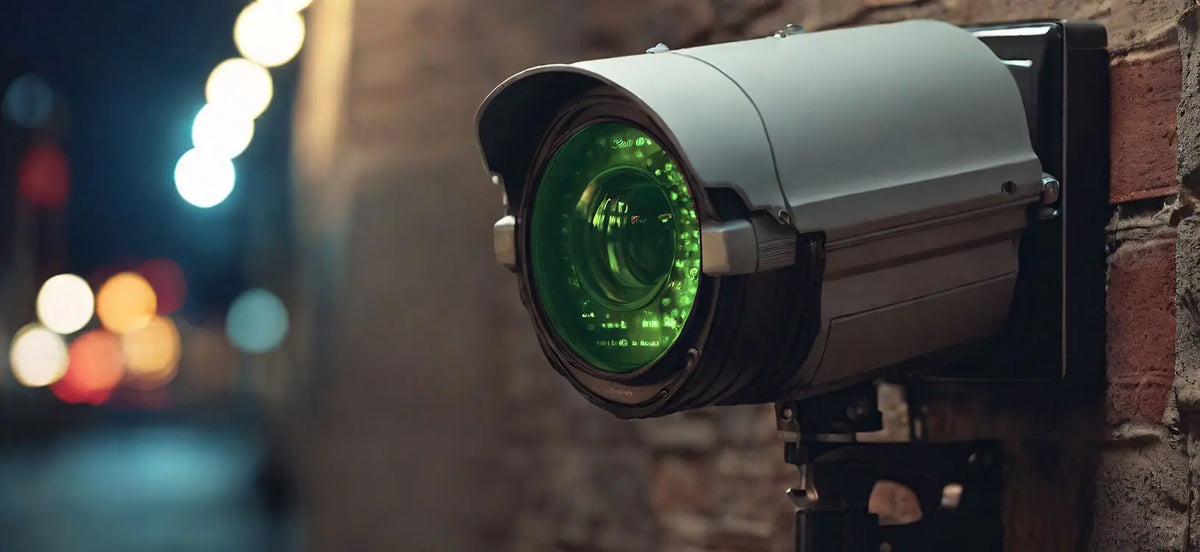
An image intensifier tube (IIT) is an electro-optical component in traditional night-vision devices. Light reflected from objects enters through the objective lens and reaches a photosensitive surface inside the tube. The tube converts the optical image into electrons, increases the number of electrons, then converts the resulting pattern back into light. An eyepiece lets the observer view that intensified image. The tube is not a camera in the ordinary recording sense: the viewer looks at the output directly, unless the device also includes separate recording equipment.

The light available to the tube may come from moonlight, starlight, sky glow, or artificial sources. The exact usable amount depends on the scene, atmosphere, optics, tube, and observer. When ambient light is insufficient, a compatible infrared (IR) illuminator can add illumination. IR illumination is not magic or universally invisible: whether its output is visible to people or other equipment depends on its wavelength and the observer’s sensitivity. It also illuminates only where the beam reaches and reflects from surfaces.
The image-intensification process, step by step
- The objective lens gathers light. The lens collects the faint scene and focuses its image onto the tube’s input. The tube can only work with the light that reaches it; a blocked view, opaque barrier, or completely unilluminated scene cannot be made transparent by intensification.
- The photocathode converts photons to electrons. Photons striking the photocathode release photoelectrons. The photocathode’s response depends on its material and the wavelengths arriving at it. In practical terms, it begins the conversion from an optical image to an electronic one.
- The microchannel plate multiplies electrons. In many modern intensifier designs, an electric field draws electrons into a microchannel plate (MCP), a plate containing many tiny channels. As electrons interact with channel walls, secondary electrons are released, creating an electron-multiplication cascade. This multiplication increases the signal while the spatial pattern carries information about the original scene.
- The phosphor screen converts the signal back to light. Electrons leaving the MCP strike a phosphor screen and produce photons. Because the electron pattern corresponds to the scene entering the tube, the screen displays an intensified image. A fiber-optic output window and eyepiece guide and magnify that image for viewing.
This chain—photons to electrons, electron multiplication, then electrons back to photons—is the core distinction between an image intensifier and a thermal sensor. A tube amplifies an image formed from available light; it does not measure temperature. Exosens describes the same photocathode, MCP, and phosphor sequence in its technical overview of night-vision tubes. The design also includes supporting elements such as an input window, power supply, and output optics, so the tube is a system rather than a single “amplifier” layer.
Why the picture may look grainy or uneven
Intensification makes a low-light image visible, but it does not guarantee a perfectly clean picture. When little light reaches the objective, the useful scene signal is weak. Random variation becomes more noticeable, and the viewer may see scintillation or grain-like noise. Image quality depends on the whole optical chain and the scene, not just a generation label or one advertised number. Focus, motion, atmospheric conditions, contrast, tube characteristics, device alignment, and the user’s visual adaptation can all affect what is perceived.
Bright point sources can appear with a surrounding halo, and strong illumination may reduce detail in nearby parts of the view. Some tubes include automatic brightness or gating features intended to manage changing illumination, but the exact behavior varies by model. These features are not permission to expose a device to sunlight, lasers, headlights, or other intense sources. Follow the device manual’s warnings and operating instructions; never deliberately test a tube by pointing it at a bright source.
Phosphor color is another visible difference. Green and white phosphor tubes both convert the electron pattern into visible light. The screen’s color changes the appearance of the displayed image, but color alone does not establish that one tube provides greater detection capability. Exosens notes that its P43 green and P45 white phosphors have similar decay-time properties and reports no laboratory performance or soldier-trial combat-effectiveness difference between them. Treat claims about color as model-specific unless supported by a relevant test, rather than assuming white is automatically clearer or green is automatically more capable.
Image intensifier, digital night vision, and thermal compared
“Night vision” is often used as a broad category, although devices can form an image in different ways. Traditional intensifier systems use a vacuum tube. Digital night-vision systems use an electronic image sensor and process the sensor output for a screen or electronic viewfinder. Thermal imagers detect infrared radiation associated with temperature and render differences as an image. The following comparison describes general operating principles, not guaranteed results for every product.
| Technology | What it senses | How the view is formed | What it is useful for | Important limitation |
|---|---|---|---|---|
| Image intensifier | Available reflected light, including relevant visible and near-infrared wavelengths | Photocathode converts photons to electrons; an MCP multiplies them; phosphor converts them back to light | Viewing scene structure and visible-light detail in low-light conditions | Needs ambient light or compatible added illumination; intense light can be hazardous to the tube |
| Digital night vision | Light detected by an electronic image sensor | Sensor signals are processed and shown on an electronic display | Digital viewing and, on some systems, electronic features such as recording | Performance depends on the sensor, optics, processing, display, and available illumination; not all devices behave alike |
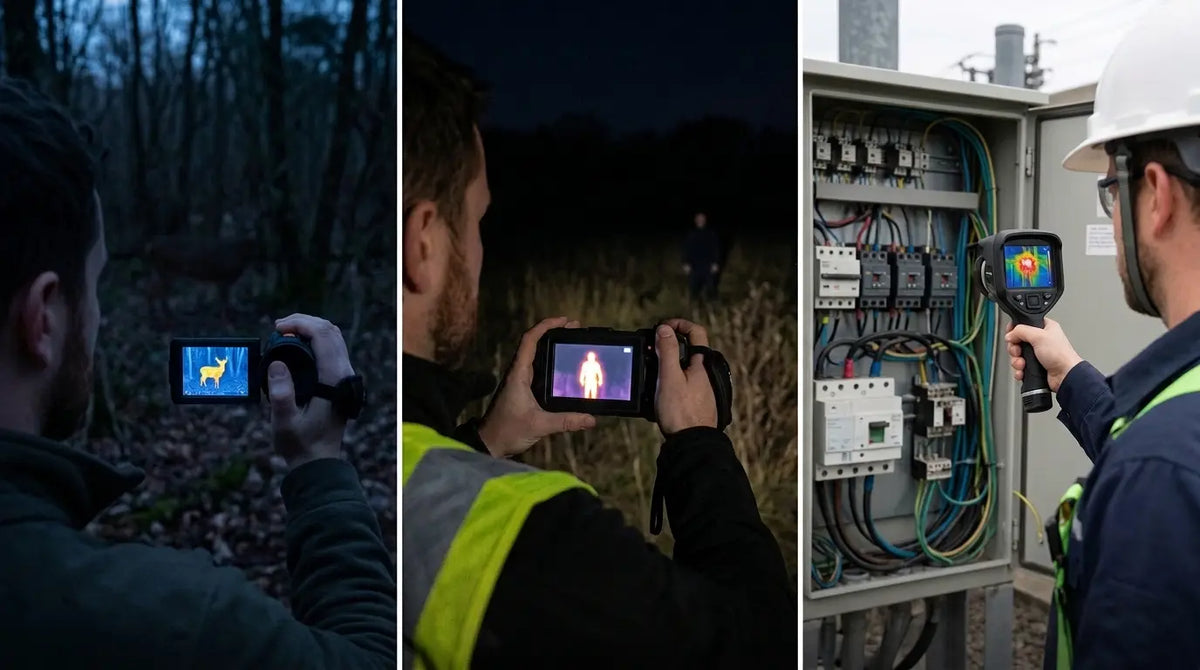
| Thermal imaging | Infrared radiation associated with differences in surface temperature | A thermal detector maps measured radiation into a displayed image | Locating warm or cool features by thermal contrast, including when visible light is absent | It does not provide a normal reflected-light view or see through solid barriers; contrast and conditions affect the image |
A useful choice begins with the task. If the priority is understanding terrain, paths, equipment, or other visible scene features, an image-intensifier view may feel more familiar when illumination is adequate. If the goal is to notice a temperature contrast, thermal may be more suitable. Neither technology guarantees detection or identification: distance, obstructions, weather, target contrast, optics, device settings, and user skill all matter. A combined workflow can use one technology to locate activity and another to inspect context, but it requires compatible equipment and should be practiced safely.

What “generations” and tube ratings mean
Image-intensifier generations are commonly used as broad labels for historical technology families, but the terminology is not a universal scorecard. Design details and conventions differ among markets and manufacturers, and a label by itself does not tell you exactly how a device will perform in your conditions. Technical characteristics such as resolution, signal-to-noise ratio, sensitivity, gain, and blemish specifications describe different aspects of a tube; they should be interpreted together and in the context of the test method and complete device.
For example, resolution concerns the ability to distinguish fine spatial detail, while signal-to-noise ratio describes the relationship between image signal and background noise. Neither measure alone predicts every real-world result. A clear comparison requires like-for-like specifications and an understanding of the complete optical system. For buying decisions, use the product’s current manufacturer documentation, confirm the exact tube and configuration, and ask how a claimed specification was measured. Avoid treating generic online range figures as promises: observation distance is strongly dependent on target size, contrast, illumination, weather, optics, and what “see” is intended to mean.
For an additional explanation of tube grading and terminology, see AGM’s overview of night-vision image-tube grades. As with any retailer or manufacturer material, use that article as background and check the exact product documentation before relying on a specification.
Practical limits and safe use
Image intensification improves visibility; it does not remove every obstacle to seeing. Dense vegetation, walls, closed doors, and other opaque objects block the optical view. Fog, smoke, rain, dust, and other atmospheric or environmental conditions can reduce contrast or scatter light. A dark surface may return little light, while a reflective or bright source can affect the scene differently. An IR illuminator can help when compatible, but its beam, power, wavelength, and reflections shape the result. Do not assume a device will perform identically in a bright urban setting, under an overcast sky, and in a dark wooded area.
Protect the tube from bright-light exposure as directed by its manufacturer. Use lens caps when appropriate, avoid pointing the device toward the sun or intense artificial sources, and observe any restrictions on use with lasers or weapon-mounted systems. Mounting, focus, adjustment, and maintenance should follow the manual for the specific model. If you use night-vision equipment outdoors, maintain ordinary situational awareness: the device narrows or changes your visual experience and does not replace safe navigation, training, or compliance with applicable laws.
To compare the light-amplifying approach with heat-based imaging, read AGM’s night vision versus thermal overview. For product selection, start with AGM’s night vision product category and review the specifications and user manual for the exact device, rather than inferring capabilities from a category name.

Frequently asked questions
Does image-intensifier night vision work in total darkness?
Not without light reaching the tube. An intensifier amplifies available light; in very dark conditions, a compatible infrared illuminator may add illumination. The result depends on the device and scene, and an illuminator does not make every surface visible.
Is image-intensifier night vision the same as thermal imaging?
No. An image intensifier amplifies an image formed from available light. Thermal imaging detects infrared radiation associated with surface-temperature differences and displays that contrast. They produce different kinds of information and have different limitations.
Does white phosphor automatically perform better than green phosphor?
No. Phosphor color describes the visible output appearance, not a universal performance ranking. Compare the specifications of the exact tube and device, and avoid assuming color alone proves greater detection or image quality.
Sources
- Exosens, Frequently Asked Questions: Night Vision — image-intensifier operation and phosphor notes.
- Exosens, Night Vision — manufacturer overview of image-intensifier components and operation.
- AGM Global Vision, What Are the Various Grades of Night Vision Image Tubes?
- AGM Global Vision, Night Vision vs. Thermal Vision: What to Choose?